

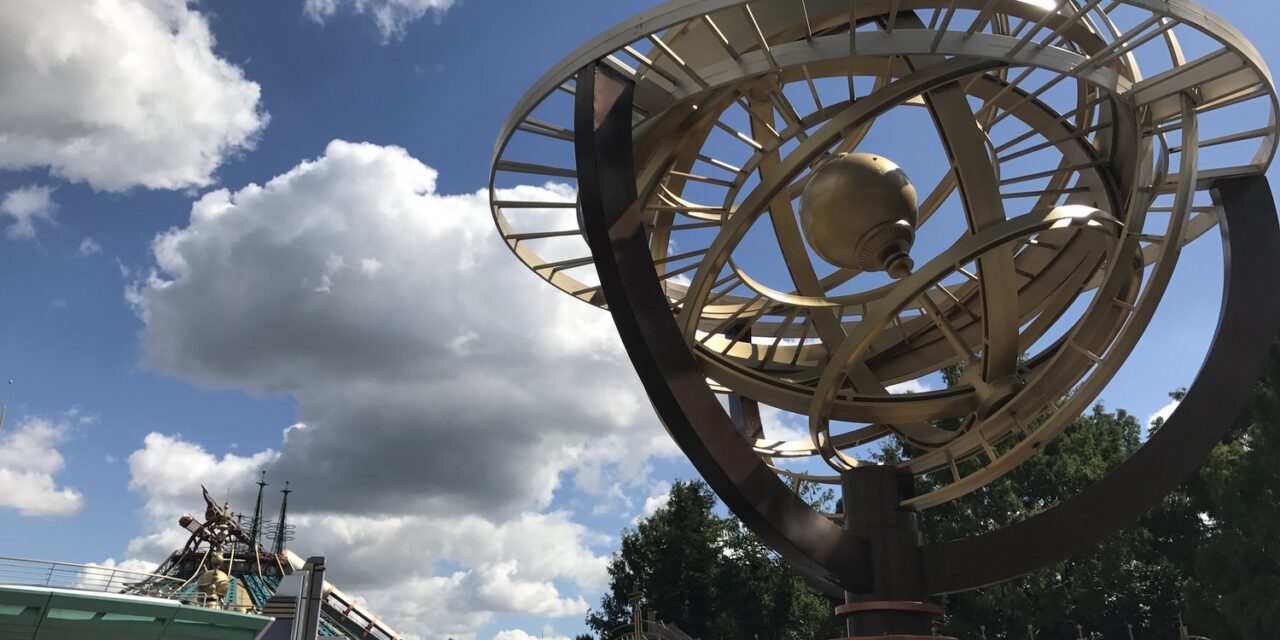
In 1992 a French park commissioned an original electronic score for its land of the future. Every other one plays a medley.
If you have walked through Tomorrowland at the Magic Kingdom any time since 1994, you have walked through a copy. The retro-futurist look, the Jules Verne and Flash Gordon palette, even the rockwork that replaced the waterfalls at the entrance — all of it came from a land built two years earlier outside Paris, the one Disney decided not to call Tomorrowland at all. It was named Discoveryland, and a serious proposal circulated to rename the Florida land after it.
The American parks copied the concept, the architecture and the colour scheme. They did not copy the music. Everywhere else, the background loop of a land of the future is assembled — library recordings, instrumental arrangements of ride songs, medleys. In Paris the Imagineers decided it had to be written. An original score, commissioned for that place and no other, and the only land in the park to be given one.
I write atmospheric electronic music. So this story interests me less as park trivia than as a case study, because it asks the question I face every week when I open Ableton: how do you make a sound that does not go out of date? Discoveryland is thirty-four years old and its music has not aged. That is not luck. It is a method, and it can be taken apart.
A land born from an abandoned project
The story starts in California in the late 1970s, and it starts with a failure. Imagineer Tony Baxter was developing Discovery Bay, a district to be built along the Rivers of America: a Jules Verne take on the San Francisco waterfront, with a Nautilus restaurant and a ride drawn from the film The Island at the Top of the World. The film flopped. The project went back in the drawer.
About a decade later Baxter was put in charge of designing Euro Disney. Discovery Bay came back out — not as a single attraction but as the entire backbone of the Paris land of the future, renamed Discoveryland.
The change of name was not cosmetic. It solved a problem the American parks had been carrying for twenty years: the future keeps arriving. The California land that opened in 1955 was meant to depict a city set in 1986, and reality caught up with it. The Paris answer was radical — do not depict the future, depict the futures people imagined in the past. Discoveryland is not the land of the future, nor of a future, but of futures: Orbitron and its flying machines summon Leonardo da Vinci, the Nautilus and Space Mountain summon the nineteenth century, Star Tours summons ours.
A future set in the past cannot age, because it is already dated by design and nothing can date it further.
And that is precisely why a Mellotron string patch or a Jupiter-8 pad does not sound stale in 2026 while a brand-new preset sounds vintage within eighteen months. The older timbre is not pretending to be modern. It is the sound of an imagined future, and it is timeless because it was never contemporary with anything.
Bernard Herrmann, and an instrument you never touch
That still had to be turned into sound. Tim Delaney, the Imagineer leading the land, started from a single reference: Bernard Herrmann, and two scores he considered the essence of science-fiction sound.
Journey to the Center of the Earth (1959) first, where Herrmann made an orchestration decision no composer of his standing would have risked: he removed the strings. In their place, five organs, harps, percussion and brass. The result sounds like no orchestra you know, and it does not sound electronic either. It sounds like elsewhere. Then The Day the Earth Stood Still (1951), where Herrmann used a theremin.
That instrument deserves a stop, because it is the thread running through this whole story. Invented in 1920 by the Russian physicist Léon Theremin, it was the first electronic instrument to be mass-produced, and above all the first the player never touches: two antennas, one hand for pitch, one for volume. That absence of a body explains its career. A violin sounds like a wooden object being rubbed. A theremin sounds like a presence.
Four dates tell the rest. In 1929 Theremin recorded a demonstration of his own instrument — the track that opens my Electronica anthology. In 1951 Samuel Hoffman made it the official sound of the uncanny on screen, six years after Miklós Rózsa had used it for Hitchcock. The instrument then fell out of favour, displaced by machines that were easier to play — except that one young enthusiast kept building and selling them through the lean years: Robert Moog, whose theremin sales paid for his studies and then for his synthesizers. The synthesizer was born on theremin money. Finally, in 1997, Jean-Michel Jarre played one on Oxygène 7-13, and has never left it behind on stage since. You can see an RCA model in the collections of the Musée de la musique at the Philharmonie de Paris. The French lineage running from the studio experiments of the 1950s to Jarre is a story I have told elsewhere.
The instrument has always fascinated me, and I have never had the chance to play one. It is the same unfulfilled wish as touching a laser harp. One correction while we are here, because the opposite is often repeated: the sound on Good Vibrations is not a theremin but a Tannerin, a ribbon instrument you do touch.

A commission, not a compilation
The Imagineers had their reference, and they hit a wall: the character of Discoveryland would not fit inside any existing music. Nothing in the catalogue worked, and assembling was out. So they commissioned an original score, which is both rare and expensive. To measure how rare: within the same land, the Space Mountain queue recycles pre-existing pieces.
The composer was David Tolley, a pianist from the world of film music who was already interested in electronic music. His profile was described as both classical and modern — exactly the intersection the land required. Sources contradict each other on his background, and I would rather say so than pick one at random.
The working method, though, is well documented, and it is the part I keep. Delaney did not hand Tolley a musical brief. He handed him drawings, concepts, a video of the first Crater Pools tests, and a list of words meant to capture the spirit of the place. Timelessness, mystery, glory. Two of them survived into the track titles: Discovery and Timeless. The technical instruction fitted in one sentence — one hour of music, looping endlessly, accompanying no specific scene but an atmosphere.
Then there is the constraint nobody mentions, and it made me put my coffee down. Tolley had six months. He could not have the score recorded by an orchestra, so he played every instrument himself — percussion, strings, brass. The music that gives a Disneyland Paris land its identity was produced by one man, at the machines, on a tight deadline. That is exactly the situation of any independent composer in 2026.
His way of breaking the problem down is worth stealing outright. Rather than write an hour in one block, he split it into four fifteen-minute segments, each foregrounding a different theme — mystery, glory. Two benefits: every idea gets developed on its own terms, and if the client dislikes a passage, only a quarter of the work is at stake instead of the whole track. That is risk management applied to composition, and I have never read it in a music production manual.
Which raises the obvious objection: four fifteen-minute blocks with different dominant themes is a recipe for hearing four pieces stuck end to end. A musician who analysed the loop in detail supplies the answer — the entire hour is welded together by a single key, C major. When a piece does not end in that key, a crossfade brings it back to the base tonality or to the intended harmony. Heavenly Flight is the model: two distinct themes in C major, then a second part climbing from A flat major back to C major through a harmonic sequence.
That is a lesson in architecture I did not expect from a theme park. You do not build continuity out of transitions. You build it out of a constraint held across the whole duration, and the transitions merely lead back to that constraint.
The result carries the marks of the method. The writing is deeply pianistic, with a deliberate echo of late nineteenth-century French music: the arpeggios of Heavenly Flight recall the finale of The Carnival of the Animals, Hilary’s Discovery leans towards Debussy, A French’s Maiden Waltz nods to Émile Waldteufel. Over all of it, electronic timbres to which Disneyland Paris explicitly credits the land’s out-of-time quality.
These are sounds that are strangely dated and timeless at once, and it was a bold bet. I am not convinced a production like that would get approved today, so clearly do the timbres point to the synthesizers of the seventies and eighties — and yet nothing else is imaginable for Discoveryland. Under pressure from fans, Disneyland Paris has started releasing its signature pieces. Not the land loops. Not yet.
What the other parks copied, and what they left behind
Here is what each land of the future actually plays:
| Park | Area music |
|---|---|
| Disneyland Paris — Discoveryland | Original score commissioned from David Tolley (1992) |
| Magic Kingdom, Orlando | Loops assembled by Jack Wagner, then 1940s Raymond Scott Quintette recordings, then a newly recorded Scott soundalike |
| Disneyland, Anaheim | No complete area loop at all before 2005 |
| Anaheim, Orlando, Tokyo, Hong Kong since 2004 | The same medley, arranged by Dan Foliart from instrumental versions of ride songs |
| Shanghai | A clean break: no Space Mountain, TRON as the headliner |
The Foliart medley is usually presented as a tribute. It is something else. It is built from ride songs — There’s a Great Big Beautiful Tomorrow, Miracles From Molecules — so it does not tell you about the place: it rewards you for recognising, and it does so from the same file on four continents. The charge is not that Disney uses licensed properties. It is harsher than that: composing gave way to quoting. Musicologists working on this material have shown that a theme-park compositional style genuinely exists, with its own devices — large instrumental masses, few layers of texture, abrupt transitions masked by sound effects.
The lands of the future that left me coldest are precisely Orlando’s and Tokyo’s. Not for lack of attractions, obviously, but in atmosphere — and atmosphere is largely a matter of music. You notice it late in the evening, sitting near the rocks, when all you want is to sit still. France offers the counter-demonstration without Disney too: the Egyptian area of Parc Astérix has a score written for it by Patrice Peyriéras, and it produces exactly that feeling of belonging to a place.
What Star Wars took, and what it could not take
In 2017 Star Wars took over Space Mountain. Precision matters here, because the confusion is easy: the music of the land and the music of the ride are two separate objects, written by two different composers three years apart. David Tolley, in 1992, wrote the area loop — what you hear outdoors as you walk. Steven Bramson, in 1995, wrote the score for Space Mountain: De la Terre à la Lune, on board and in the queue. In 2005 Michael Giacchino succeeded him for Mission 2; in 2017 Hyperspace Mountain erased Bramson.
Tolley’s loop never moved. It survived Star Tours, the closure of Le Visionarium, the arrival of Buzz Lightyear, two rethemings of the mountain and a decade of Star Wars seasons. Thirty-four years on, it is still playing. Licensed properties attach to attractions; they do not attach to the identity of a place.
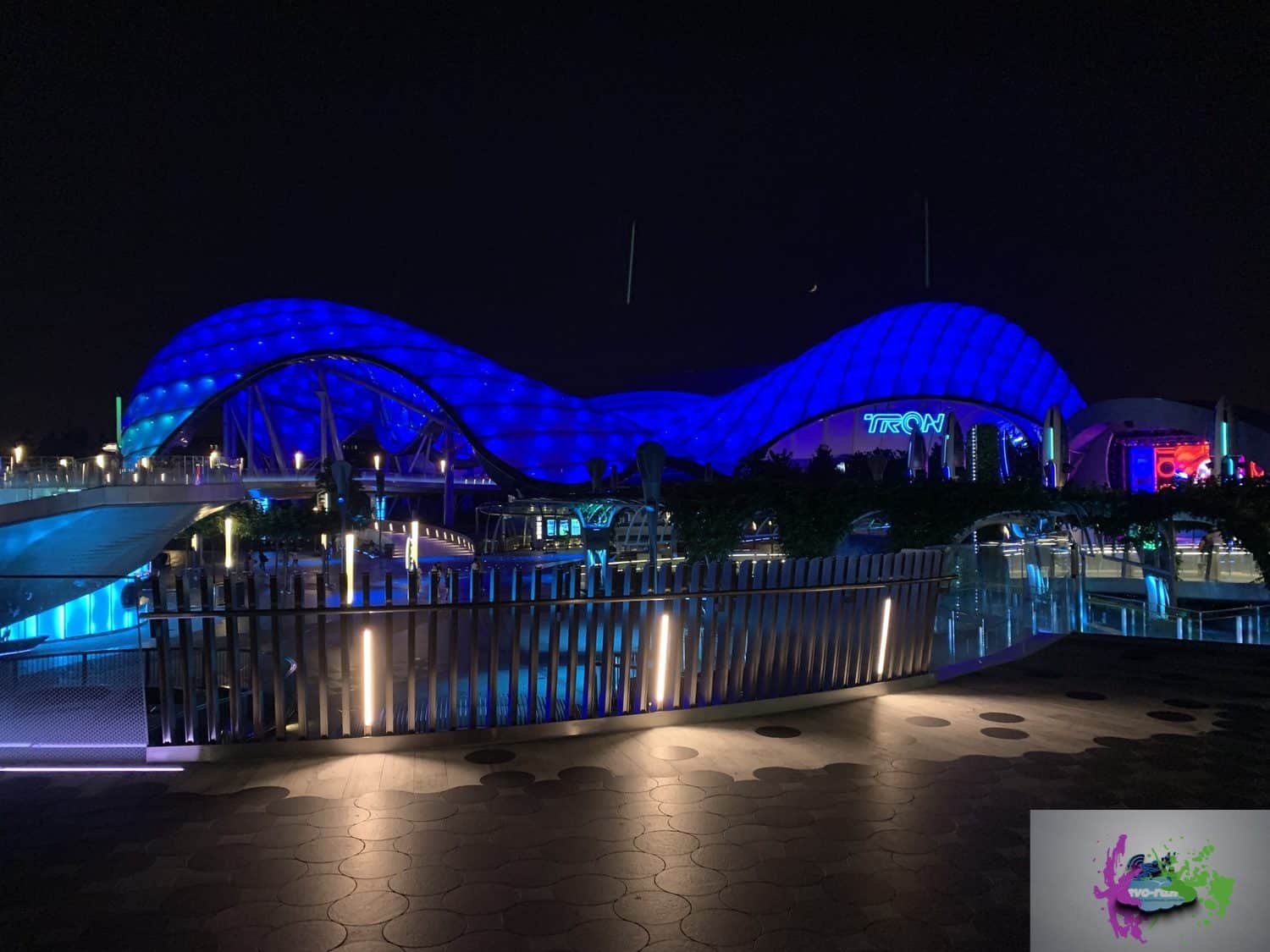
I am not among those who sneer at Hyperspace Mountain. The ride was enjoyable, if cobbled together, and there was nothing shameful about riding the Star Wars revival. But it distorted Space Mountain, and more importantly it destabilised the whole land by giving disproportionate weight to one property that had only ever been one future among several — assuming we are even talking about the future, given that it all happened a long time ago in a galaxy far, far away. I would have preferred an addition to a replacement: TRON, for instance, which would have brought one more future, the one made of virtual reality and artificial intelligence. That ride made a lasting impression on us at Shanghai Disneyland. Discoveryland does not lack personality. It lacks attractions.
Stranger still: the music of Le Visionarium, an attraction closed for more than twenty years, is still played at the Disneyland Railroad departure in Discoveryland station, and occasionally on the moving walkways of the visitor car park. Music written for a place that no longer exists keeps looping next to a railway platform. That is a fair definition of what background music does — it outlives the thing it accompanied.
August 2026: a park decides that music is heritage
At D23 in Anaheim in mid-August 2026, Disney announced that Hyperspace Mountain will close at the end of 2027 and return as Space Mountain: De la Terre à la Lune, with the Jules Verne theme, the Stellar Way in the queue and the Columbiad cannon restored. I went through the full set of Disneyland Paris announcements separately; here only one line matters. Steven Bramson’s score comes back, fully remastered.
The same weekend, Disney announced that Tokyo’s Space Mountain is being rebuilt from the ground up and will reopen under an entirely new theme, Space Mountain Earthrise. Two parks, two opposite strategies. Tokyo starts from scratch; Paris remasters music from 1995.
Put differently: in 2026 a global entertainment company decided that a thirty-year-old score is not scenery to be replaced but heritage to be restored. Nobody remasters what has dated. You remaster what you still judge to be right. Fans had been campaigning for the return of the moon since 2012, and I admit to some satisfaction at seeing a campaign I was relaying fourteen years ago finally land. The 1992 bet still holds: an imagined future does not expire.
Listening to the future we never got
Four things from this story have entered my own practice. The word list first: before opening a project, write five or six words for the place I want to build, and listen to no references — it produces less pastiche and more decisions. Tolley’s segmentation next, his four fifteen-minute blocks: split a long piece by dominant theme rather than writing it straight through. The double time layer: pair a historically dated musical gesture with a timbre that has no age, and you get a period that never happened. And the refusal to quote, which is the hardest, because it is always more comfortable to let listeners recognise something than to make them feel a place.
That leaves the question this article opens and does not close, and it is a real compositional problem: how can a loop run all day without anyone hearing it start over? Tolley answered with an hour of material, four themes and a single key. There are other answers, far more economical. I work from a mobile sketchpad and a small studio, so I will come back to it once I have tested them rather than before.
This is what I am after with Rê>ON. Éphémère, from Les Souvenirs Connectés, is the most direct application of it — and if you want to hear where this sits in the wider French scene, ten contemporary artists worth your time make a good starting point.
Every new Rê>ON track lands in your library the day it comes out. Follow.
If this kind of piece is your thing, the Rêves Connectés letter goes out once a month on atmospheric electronic music, its pioneers and how it gets made. One field, no spam.

