
The French lineage of electronic music, from recorded noise to the pads that fill stadiums
You can tell the story of electronic music as a great global epic — that’s what my Electronica anthology does, from the 1950s to today. [link the /en/ version of the anthology] But there’s a tighter story, a more French one, and for me a more intimate one. It begins in a radio studio in 1948 and runs all the way to the synth pads that filled the Place de la Concorde in Paris, then the Stade de France. Between the two, a thread pulled taut by one man — Pierre Schaeffer — and extended by his most famous pupil, Jean-Michel Jarre. That thread isn’t a list of dates. It’s a way of making sound that still shapes how I compose today.
1948: two births in the same year
In 1948, two things came into the world within months of each other: a kind of music, and a musician. That year, Pierre Schaeffer — an elite engineer turned radio man — invented musique concrète: composing from real, recorded, then manipulated sounds. On 5 October 1948, France’s public broadcaster aired his Concert de bruits (“concert of noises”): trains, spinning tops, saucepans, presented as music. The most famous of these pieces, the Étude aux chemins de fer (“railway study”), was built from locomotive sounds captured at a Paris station.
Contrary to legend, there was no scandal. Schaeffer feared protests; he received a dozen letters, friendly and curious. The real shock wasn’t the noise, but the question it posed: is this still music? Thirty years earlier, the Italian Futurists and their “noise concerts” had triggered actual brawls; on the radio, the same provocation lands differently, and opens a door instead of slamming it.
What you heard that night wasn’t gratuitous din. It was an attempt to draw a form of poetry from the very sounds that “noble” music had always cast aside: the creak, the impact, the friction. Schaeffer started from a premise that was radical for its time — there is no clean border between a musical sound and a noise; any material can serve music.
That same year, on 24 August, Jean-Michel Jarre was born in Lyon. Chance did its work well: the man who would carry this music to the wider public is exactly as old as musique concrète itself.
Composing with sound, not with the note
Here’s the idea that changes everything, and it fits in one sentence: stop composing with notes, start composing with sounds. A train noise is no longer the illustration of a train; it’s a material you cut, loop, reverse. Schaeffer called it the sound object. To isolate one, he worked with the closed groove — a loop cut into a record that spins endlessly. That is, fifty years early, the principle of the sample and the loop that drive all of today’s electronic music.
There’s even a word for the kind of listening it demands, borrowed from Pythagoras: acousmatic — hearing a sound without seeing its source. When I lay down a pad and let the listener guess where it comes from, I’m doing acousmatics without thinking about it. Everything Schaeffer later theorized in his Traité des objets musicaux (1966) has passed into our reflexes as producers: we judge a sound by what it does to the ear, not by the instrument that produced it.
Still, it has to be said: those concerts of noise were a long way from the melodies that would make Jarre and his heirs famous — and that may be what people still hold against the genre. Because there’s the limit, and the paradox: musique concrète claims to do without notes, but in the end, everything becomes a note again, everything becomes music again. It’s simply performed differently, with other instruments and other tools.
Every new Rê>ON track lands in your library the day it comes out. Follow.
Two years at the GRM, and the making of a legend
Jarre met Schaeffer in 1968 and, in January 1969, joined the Groupe de recherches musicales (GRM), the institution Schaeffer had founded in 1958. He stayed two years. Two years is short. And yet it’s Schaeffer whom Jarre still names as his master today.
Look closely at the facts. As early as 1966, Schaeffer had stepped back from the GRM’s daily work; he handled theory and lectures. Jarre learned the machines hands-on alongside François Bayle and Bernard Parmegiani — it was in Parmegiani’s studio that he quietly improvised his first pieces on an EMS VCS3 synthesizer. Parmegiani, one of the GRM’s great masters, remains an immense and under-recognized composer; his piece Sous le pont d’Avignon sits in my Electronica anthology, next to the pioneers. The legend says “Schaeffer’s pupil”; the facts say “an intern trained by Schaeffer’s heirs.” Both are true. Time smoothed the relationship, as it often does: the master became a guiding figure, and the pupil built his story around him.
Another nuance the legend forgets: Jarre’s taste for tinkering with sound didn’t come from the GRM. It came from his grandfather — a musician and tinkerer, co-inventor of one of the first mixing consoles in French radio — who had given him his first tape recorder. Schaeffer gave a framework to an instinct that was already there.
Oxygène: the break, and origins finally owned
What Jarre did next was a betrayal, in the best sense of the word. The GRM world looked down on popular music; the synthesizer was a ridiculed instrument. With Oxygène, in 1976, Jarre took the material out of the lab and added what the avant-garde refused: melody. The album, recorded in a makeshift home studio, has sold a figure most often estimated at around 18 million copies. There’s the break: French electronic music stopped being a researchers’ affair and became music everyone hums. Three years later, a million people at the Place de la Concorde turned it into a mass art form — the start of a long history of concerts.
A break in his own path, too. Before Oxygène there is an experimental, tinkering Jarre: library music (Deserted Palace, 1973), a long-overlooked soundtrack (Les Granges Brûlées, 1973 — one of the very first fully electronic film scores, made from a VCS3, a Farfisa organ and three synced Revox tape machines), a first, confidential single (La Cage, 1971). For a long time he left these tracks in the shadows. Then he reclaimed them: in 2018, Planet Jarre gathered fifty years of career, including these youthful pieces, chosen and reworked by him — and announced, in its wake, Équinoxe Infinity, a sequel to Équinoxe forty years on. The paradox is real: Jarre put his youthful experiments back in the spotlight at the very moment he let some later, less-defended projects fade — the mini-album Together Now, co-produced in 1998 with Japanese producer Tetsuya “TK” Komuro for the World Cup, or Téo & Téa (2007); their duo The Vizitors never saw the light of day. What he pulled back out of the drawer wasn’t those tracks — it was his laboratory roots.
Jarre never composed alone
We like to picture the electronic composer as a lone genius, alone at his keyboards. The reality is more collective, and more faithful to the GRM’s tinkering spirit. Two names matter. Michel Geiss, an engineer and instrument designer, built him a bespoke sequencer in 1978 during the recording of Équinoxe — the Matrisequencer 250, still heard as late as Rendez-Vous in 1986. Francis Rimbert, a demonstrator for the big synthesizer brands, became “his memory” for nearly thirty years: he knew every part of every track and brought Jarre the sounds of the latest machines. Behind a pad that seems to come from a single brain, there’s a workshop. That, too, is Schaeffer’s legacy: music made by many hands, halfway between the art studio and the workbench.
The living lineage, all the way to the Stade de France
This filiation doesn’t stop with Jarre. It runs through the French touch of Daft Punk and Air, the cinema of Vangelis and Hans Zimmer, and less classifiable neighbours like Mike Oldfield — that quietly cultish Briton whose long instrumental frescoes reach for the same imagination. All the ambient music this hub calls its playground descends, near or far, from these founding gestures.
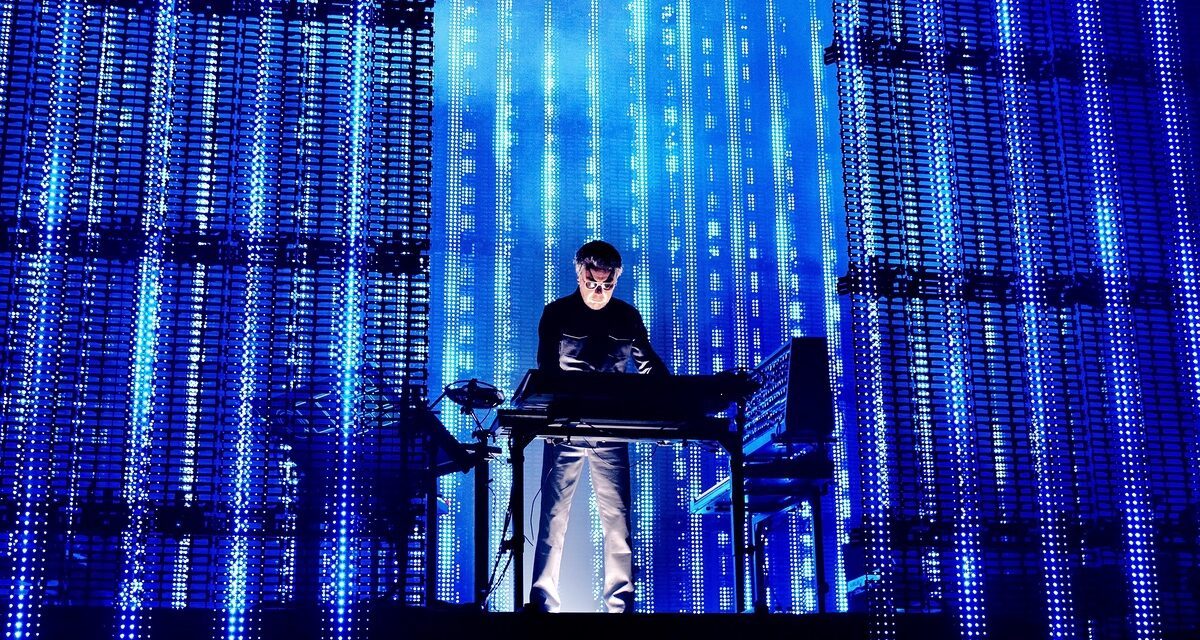
We saw it on a grand scale on 8 September 2024. For the closing ceremony of the Paralympic Games, at the Stade de France, France celebrated its own invention by gathering twenty-four artists from the national electronic scene — Martin Solveig, Kavinsky, Miss Kittin, Agoria, Polo & Pan, Ofenbach, Kungs, Irène Drésel, The Avener, among others. It was Jean-Michel Jarre — Schaeffer’s pupil — who opened the concert, before returning at the close with his laser harp. That night, he reminded us of something too often forgotten: electronic music is a heritage born in France and in Europe. The loop opened in 1948 had closed in front of the whole world.
Sound has always followed technology
Jarre put it better than anyone: from handling sound so much, we’ve all become a little bit sound designers — the grandchildren of radio’s research service. When a hip-hop producer drops a loop, when a film composer lets a pad breathe under dialogue, when I sculpt a texture in a software synth, we’re all applying, without knowing it, the lesson of 1948: sound first, the note second.
This story is also one of technological revolutions. A product manager by day and a composer by night, I see the same wave crossing both of my trades: computing and then its democratization, the internet, social media, connected devices, and today artificial intelligence. Electronic music has always embraced these shifts — every new machine becomes an instrument. I’ll devote future articles to this, because each of those stages deserves its own.
Oxymore, the loop closed
In 2022, Jarre released Oxymore, an album built from sounds bequeathed to him by Pierre Henry, the other father of musique concrète. The idea of a collaboration went back to 2015, during his Electronica project; Henry’s failing health — he died in July 2017 — had made it impossible. Henry had nonetheless recorded sounds for the occasion, and it was his widow who, after his death, handed those original materials to Jarre. He recorded the album at the Maison de la Radio — the very place where Schaeffer had started it all — and dedicated it to his two masters. Pierre Henry’s voice even resonates from the very introduction.
For me, Oxymore is the antithesis of Oxygène. Where Oxygène was luminous, melodic and immediate, this one is dark, harder to access — a return to concrete sources rather than a new flight. Seventy-four years after the Concert de bruits, the pupil closes the loop, this time spatialized in 3D. From the Étude aux chemins de fer to Oxymore, it’s the same stubborn story: turning the world’s raw material into music.
I retraced that thread backwards myself. One day, my father happened to give me a “Synthesizers” compilation — mediocre covers of the originals, but they hooked me. Enough that I then bought Jarre’s albums, this time with my mother.
It’s through him that I came to electronic music, to composition, and step by step to its origins. If this lineage speaks to you, listen to my Electronica anthology — I slip my Rê>ON tracks in among the pioneers — and drop me a line to tell me which link in this chain moves you most.