

Fifty years of catalogue, five ways in, and a sixth you can no longer hear
Twenty-two studio albums, concerts played to crowds counted in millions, and in most people’s heads a single track: Oxygène 4. That is the paradox of a body of work grown too large for its own summary. If you have ever tried to discover Jean-Michel Jarre properly, you probably did what everyone does: put on Oxygène end to end, find it long, give up. The album is not the problem. The problem is that we enter this catalogue through the door radio picked out, rather than the one matching what we already like. Jarre proposed a different method himself in 2018. Here is how to use it.
The hit is a wall, not a door
Three minutes, a melody you can whistle, the shape of a pop song: Oxygène 4 is an excellent single and a terrible sample. It does not resemble most of the catalogue, it represents a fraction of it. The listener won over by that format moves on to Zoolook and runs into a collage of sampled voices that promised nothing of the kind. Conversely, someone after music as landscape stops at the hit, finds it too talkative, and misses forty minutes made precisely for them.
The listener is not at fault. The fault lies with the idea that a discography is approached in release order. Across fifty years crossed by at least three technical revolutions, that order tells you nothing about what you will enjoy.
Fifty years in one paragraph, and the Rendez-vous turn
To place things, briefly: a prehistory at the Groupe de recherches musicales and in film scoring up to 1975; the studio decade from Oxygène (1976) to Zoolook (1984); the decade of vast outdoor shows from Rendez-vous (1986) to Chronologie (1993); a long drift from 1997 to 2007; then the rebuild opened by Electronica in 2015. The real pivot is 1986, and it is structural: from that point on, the event comes before the record. In 1985 Jarre is approached by the musical director of the Houston Grand Opera for the 150th anniversary of Texas, the 150th of the city, and the 25th of NASA. The album Rendez-vous is written in roughly two months and released four days before the concert. Two years later, Revolutions and the London Docklands show share the same three-act device — industrial, cultural and technological upheaval. The music of this period is not illustrated by the concerts: it is commissioned by them.
The pads door, for anyone after a space
In 2018, for his fiftieth year, Jarre went back through his catalogue track by track and drew an unexpected conclusion: he had not made one body of work but four, matching four ways of composing. So he arranged his anthology by style rather than by date. The first family gathers the atmospheric pieces without percussion: Oxygène 1, Oxygène 19, Rendez-Vous 1, Équinoxe 2, Chronologie 1, Waiting for Cousteau.
This is the door to take if you come from ambient, from film music, or from the quieter end of game soundtracks. It asks one thing: accepting that almost nothing happens for minutes at a time. Start with Waiting for Cousteau, forty-six minutes held on a handful of chords, and you will know immediately whether this family is yours.
One detail confirms the sorting is not hindsight: Jarre placed Oxygène 1 (1976) side by side with pieces recorded forty years later. His justification fits in a sentence — he observes that listeners concentrate on shorter and shorter fragments of music, forever skipping ahead, and would rather offer them coherent listening than a timeline.
The themes door, for anyone after a melody
The second family is the one of solid melodies and short structures. It obviously holds Oxygène 2 and Oxygène 4, but also Équinoxe 4 and Équinoxe 5, Magnetic Fields 2, Rendez-Vous 2 and Rendez-Vous 4, Chronologie 4, Zoolookologie and Industrial Revolution Part 2.
Here is where the most useful rule for a newcomer shows itself: what you like in Jarre is almost never an album, it is a family. If Oxygène 4 worked for you, the next thing to play is not the rest of Oxygène, it is Équinoxe 4 and Chronologie 4, recorded fifteen years apart on machines with nothing in common. The kinship is not chronological, it is a matter of writing.
The sequences door, for anyone coming from techno
The third family rests entirely on repetitive, hypnotic loops: Équinoxe 7, Oxygène 8, Arpegiateur, Revolutions. This is the door producers walk through, and the one Jarre has most reason to defend, since it grounds his lineage with techno and club music. It has a practical advantage: these tracks make sense without historical context, they stand up in a 2026 DJ set as they stood up in 1978. It is no accident that most of them turn up in the setlists of his recent tours.
It is also the most instructive family when you produce music yourself. Listening to Équinoxe 7 while trying to name what changes, loop after loop, teaches more about arrangement than most tutorials. It is the same discipline at work in several of the French artists we covered recently.
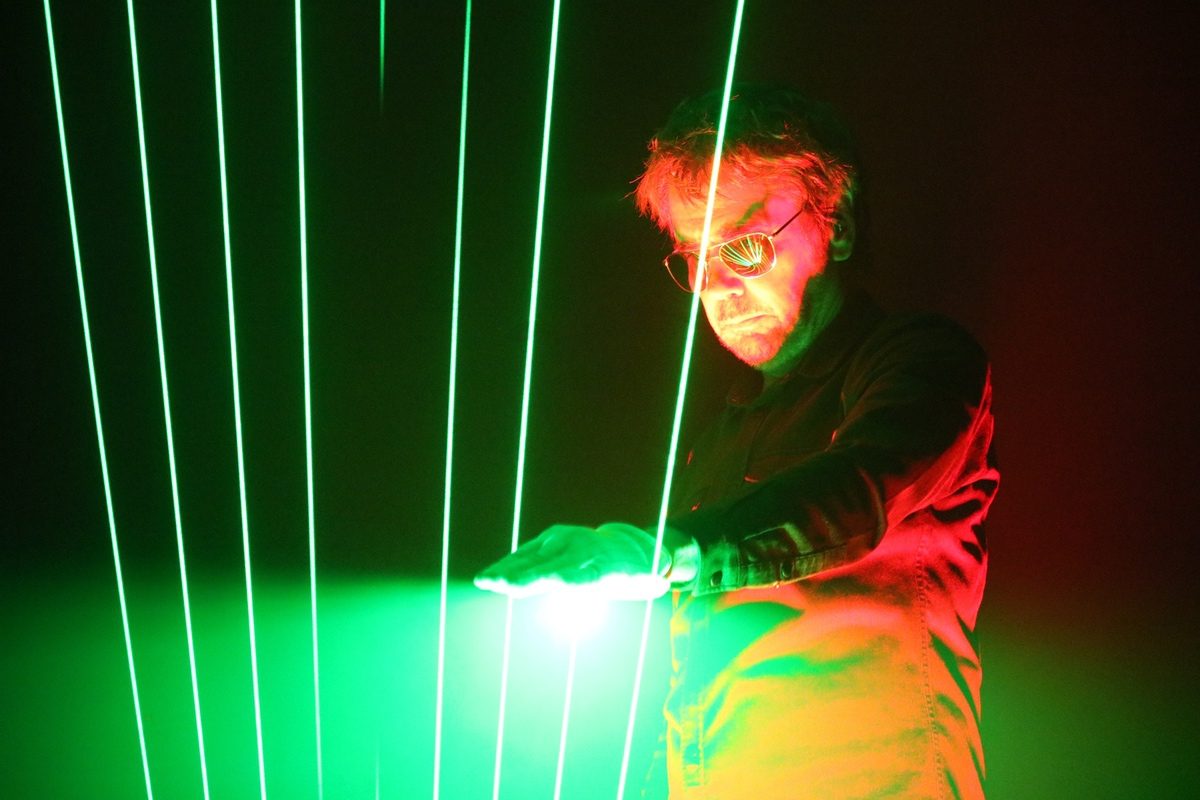
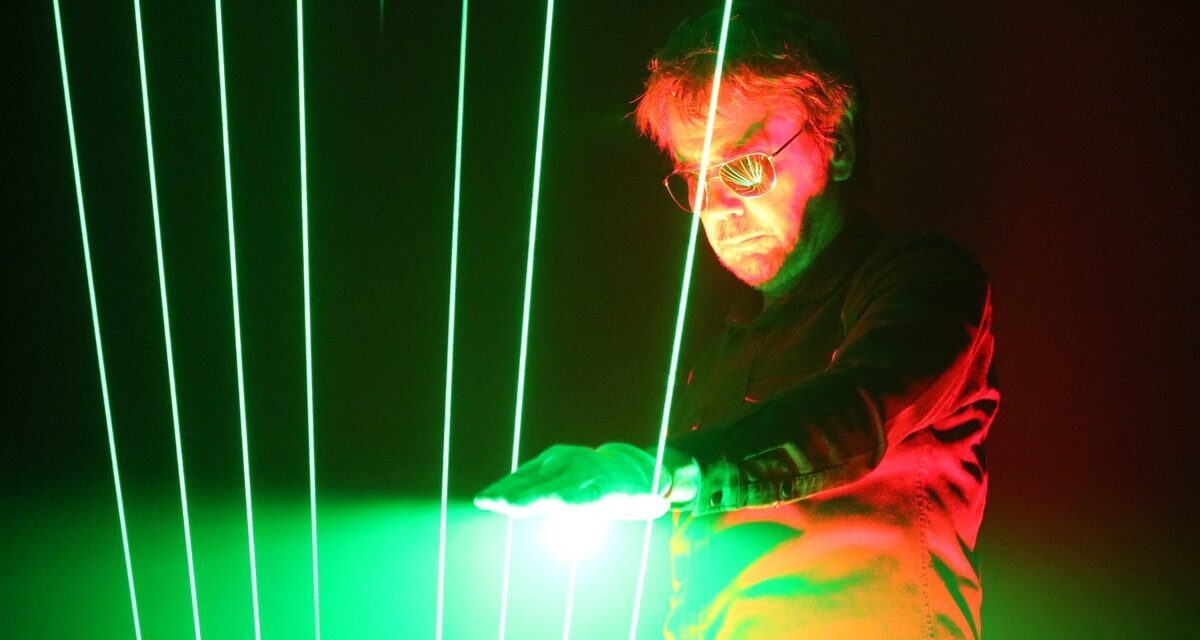
Jean-Michel Jarre at the laser harp, the instrument Bernard Szajner patented in 1982 and which has followed his concerts ever since. Photo © Milan Csaplár, CC BY-SA 4.0, via Wikimedia Commons, cropped.
The 2015 door, entering through somebody else
After eight years without an album of new material, Jarre released Electronica in two volumes, sixteen tracks each written with a guest: Air, M83, Moby, Vince Clarke, Gesaffelstein, Boys Noize, Massive Attack, Armin van Buuren, Laurie Anderson, Pete Townshend, John Carpenter, and Tangerine Dream for one of Edgar Froese’s last recordings. His method, which he sets out in Sound on Sound, was to prepare very advanced demos for each collaborator, written towards their world rather than his own.
This is the best door for a listener under thirty, because it demands no prior knowledge: you come in through an artist you already play and discover Jarre by contamination. It is also the one that follows on most naturally from our anthology of electronic music from the 1950s to today.
The sixth door: music made to order
Jarre listed only four families, but one is missing, and it is the most useful to anyone interested in ambient music: the one he writes to inhabit a place, a medium or a format that already exists. Four examples show the range. In 1988 the game Captain Blood, built on the Atari ST by Didier Bouchon and Philippe Ulrich, opens on a stripped-down version of “Ethnicolor”, taken from Zoolook — one of the earliest cases of catalogue electronic music used as a video game theme.
In 2016, the French public news channel franceinfo commissioned the complete sonic identity of its radio, television and app. He delivered in ten days, and his brief came down to one idea: whether you hear three seconds or two minutes of any sequence, you should know which station you are on. The answer holds in four notes, spun out into more than two hundred modules kept by the agency handling the identity.
I ended up listening to that work as an album, without pictures, and that is where it holds up best: of everything Jarre delivered in that period, it is one of his strongest records. The refusal of sensationalism runs all the way through — no anxious stings, no drama, where news branding usually overdoes both. I hear the opposite objection, raised during the 2016 relaunch: those textures struck some listeners as cold or too futuristic next to warmer, more familiar cues.
Then in 2021, Sebastião Salgado’s Amazônia exhibition at the Philharmonie de Paris rested on a score built from field recordings gathered in Amazonia since 1950 and held at the Musée d’ethnographie de Genève. Jarre describes precisely the traps he had to avoid: not purely ethnomusicological music, not ambient wallpaper, not spa music — and the difficulty of writing a counterpoint to a photographic set that already carries its own structure.
One last example, and the most recent: in January 2024, Renault unveiled at the UNESCO auditorium the sonic identity of its electric vehicles, composed with Jarre from his track “Crystal Garden”. I was there, and the brief stated that evening sums up this whole door in three words: discreet, familiar, recognisable without being insistent. I drew what sound design teaches product management from it.
This is the door I would recommend to anyone who loves the music of parks, games or exhibitions, because it answers the same constraint: accompany without capturing attention, and stay recognisable anyway. One territory is still missing from that list, and it is where a good part of popular electronic music comes from — the theme park, where a French pioneer wrote the most-heard piece of electronic music in history.
The closed door, the one you can no longer hear
A sixth family remains, absent from every platform, and it may be the most interesting to know about. Sessions 2000 and Experimental 2001 form a pair conceived to clear as fast as possible the contract binding Jarre to his producer Francis Dreyfus, after a personal and legal falling-out. The album’s turn towards jazz was itself a settling of scores: Jarre had previously pushed Dreyfus to steer the label that way. Experimental 2001 was never released. Sessions 2000 peaked at number 140 in France, and Geometry of Love, the following year, charted nowhere at all. Sessions 2000 is now unfindable other than through fan copies.
Same story for the title track of Revolutions: it contained samples of the Turkish ney player Kudsi Erguner, who won his case in court. From the 1991 reissues onward, the flute is replaced by synthetic approximations and the title changes. The version Jarre played at the Docklands in 1988 therefore survives only in recordings of the concert. As for the show given in Okinawa on 1 January 2001 under the name The ViZitors, with Tetsuya Komuro and stage designer Mark Fisher, it featured no hits and entirely unreleased material. It was never issued.
To that list add the most radical case of all, Musique pour Supermarché, pressed as a single copy in 1983, sold at auction, the master tapes destroyed afterwards. Jarre let only a demo excerpt surface, thirty-five years later, in his anthology. What we have here is a coherent sixth family: not failures, but records made inaccessible by a contract, a lawsuit or a deliberate gesture. It is a part of the work no platform will ever offer you, and it explains better than the rest how this career held together for fifty years. The same fate, oddly, befell the two volumes of the “Radiophonie” series carrying the franceinfo identity: released on the Radio France Signature label, and for the 2022 one sold exclusively through a single retailer, they remain off the platforms.
I have listened to these records, and I do not share the verdict of the sales charts. Sessions 2000 mixes electronics with lounge jazz, a long way from the great melodic frescoes. The writing is intimate, calm, muted, and the synthesisers imitate piano, saxophone and double bass with real skill. I have often put it on to fall asleep at the end of the day, and its absence from streaming deprives me of a record I actually use. I understand why it threw the fans: no memorable melody, no firm rhythm, and a flatness if you are after active listening. But the speed constraints under which it was composed with Francis Rimbert produced an oddity, and the oblivion it fell into strikes me as unfair. It shows one thing at least: Jarre can still put himself at risk.
Okinawa follows the same pattern at concert scale. Eight unreleased tracks, pushed towards the dancefloor by Komuro’s touch and by the Métamorphoses period, insistent rhythms, haunting melodies, Francis Rimbert on stage and Arthur C. Clarke’s patronage. Listeners attached to the analogue, cosmic years were taken aback. But the show had no echo in Europe, no promotion, no attempt to put it forward. The one electronic night I attended in Paris bore no relation to it: it rested on a compilation of remixes I did not enjoy. One still wonders what was going on behind the scenes.
Pick your door, and listen straight after
Five families, five ways in, and one simple rule: work out first what you are looking for — a space, a melody, a loop, or a name you already know — and set the chronology aside. So I have built a playlist in five segments following exactly that split, about ten tracks per door, so you can try them all in an hour and keep the one that speaks to you. You will find it just below. And if you disagree with my sorting, or a door is missing, the comments are open: that kind of disagreement always makes good articles.
Under the name Rê>ON, I compose atmospheric pads that owe a great deal to the first of these doors. Two albums are out, Connected Dreams and Les souvenirs connectés, and an EP, Discomposed, came out on 5 October.
Every new Rê>ON track is added to your library automatically, the day it comes out. Follow.





Trackbacks/Pingbacks