
There are places that carry within them the entire history of French theme parks. The site at Courdimanche, in the Val-d’Oise just north-west of Paris, is one of them. Some thirty kilometres from the capital, on this vast wasteland that nature has slowly reclaimed, once stood Mirapolis — billed at its opening as “France’s first major theme park.” Today, a persistent rumour is stirring the theme-park world, and us first of all: the world of Dragon Ball could be reborn here, backed by Saudi investors. The story, broken by Politico and then confirmed by several sources close to the matter, remains for now a negotiation conducted in the utmost discretion by the Élysée — with no official announcement. Nothing is signed. But the opportunity is too good not to look closely at what this site really tells us, and at the questions such a project raises. Let’s take the time to look at the facts.
A French pioneer born too soon
Mirapolis opened its doors in May 1987, inaugurated with great fanfare by Jacques Chirac, then Prime Minister. The park sprang from the imagination of architect Anne Fourcade, with an ambitious idea: to build a “French Disneyland” devoted not to mice or superheroes, but to our own tales and legends. The giant Gargantua, drawn from Rabelais, presided over it as a statue some 35 metres tall, visible from the A15 motorway, and even housed a ride. A detail history loves: the financing already rested, back then, on Saudi capital, through businessman Gaith Pharaon. Yesterday’s backers foreshadow today’s.
The story, alas, was brief. The park aimed for 2 to 2.5 million visitors a year; it drew barely 800,000 in its first season. Facing competition from the newly opened Parc Astérix in 1989, weakened by troubled management and repeated disputes, Mirapolis closed for good in October 1991 — after just four and a half seasons, and six months before the opening of Disneyland Paris, which would go on to redefine the entire sector. Little remains today: a concrete block at the entrance, a few vestiges swallowed by the trees. Mirapolis is no isolated case: it belongs to that generation of 1980s French parks — like Zygofolis in Nice or Big Bang Schtroumpf in Lorraine — swept away by the same wave of miscalibrated ambition.
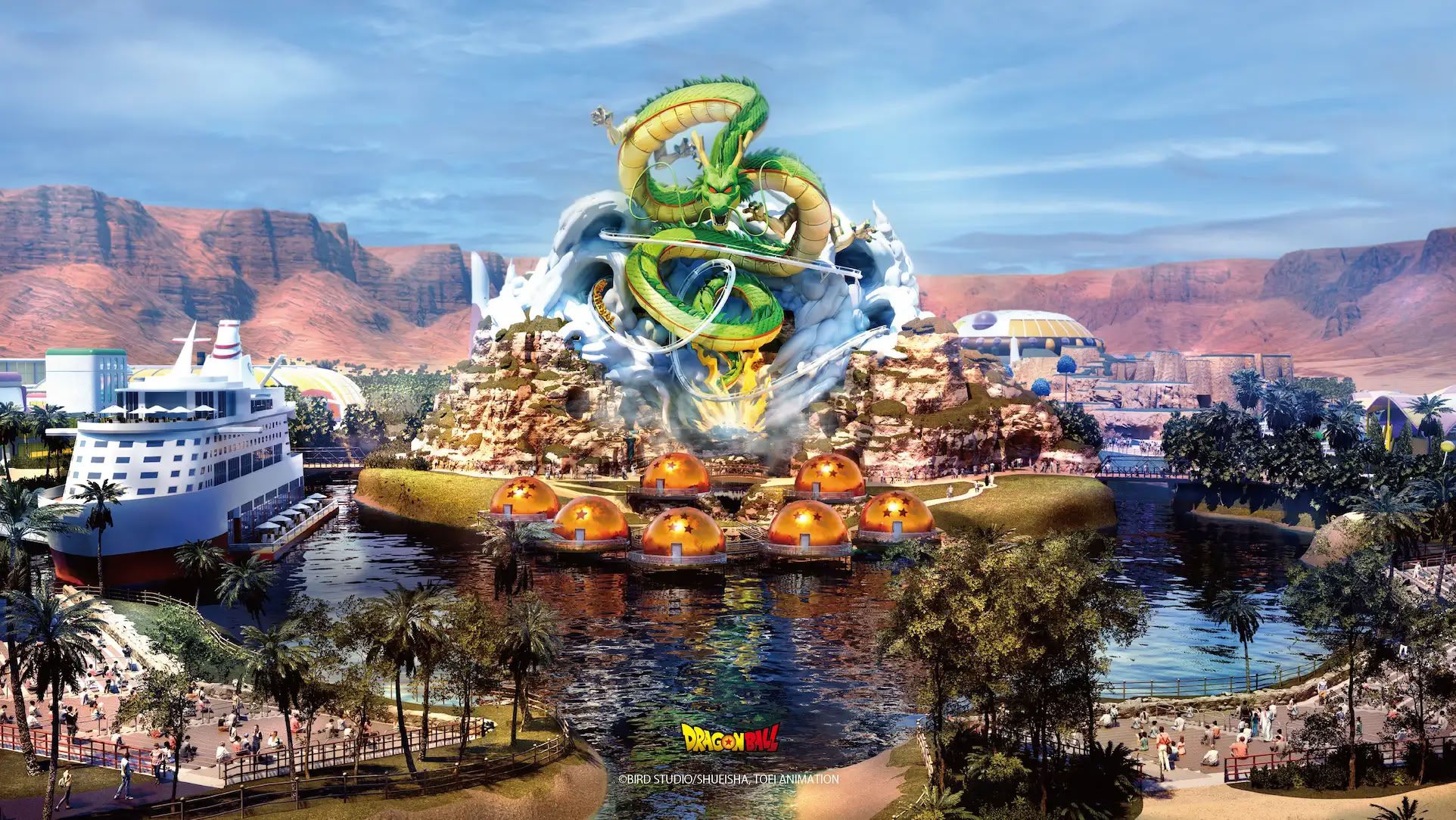
The 70-metre Shenron, centrepiece of Qiddiya’s Dragon Ball park (artist’s impression). © Qiddiya Investment Company — Dragon Ball universe © Toei Animation / Bird Studio.
55 hectares of wasteland: room to build, but how far?
This is the project’s real technical question, and it deserves a pause. The site covers about 55 hectares (older surveys put it closer to 47 to 50). At first glance, that’s comfortable. But let’s put the figure in perspective: the Dragon Ball park Qiddiya is already building in Riyadh, the global benchmark of its kind, takes up more than 500,000 square metres on its own — exactly 50 hectares. In other words, the Courdimanche site is barely the size of the flagship Saudi park.
The implication is clear. There’s room to build a serious theme park — Parc Astérix thrives on a comparable footprint. But there’s no land reserve to imagine, one day, a multi-park resort on the scale of Disneyland Paris, which sprawls over several thousand hectares with decades of expansion ahead of it. The site allows a fine park; it doesn’t promise an empire. That constraint probably explains why sources describe a French version “more modest” than the Saudi model.
The figure still needs qualifying. While the total footprint is around 55 hectares, only about thirty are currently zoned for leisure in Courdimanche’s local land-use plan (PLU); mobilising more would mean revising that document — an administrative step that is anything but trivial. Another point of vigilance, and not a minor one: access. Poor accessibility was part of what precipitated Mirapolis’s fall, and regional officials are already warning that the site’s transport links would need serious improvement before anyone can hope for millions of visitors. An available brownfield at the gates of the Paris region remains a rare asset; it still has to be made genuinely reachable.
What the Saudi model looks like
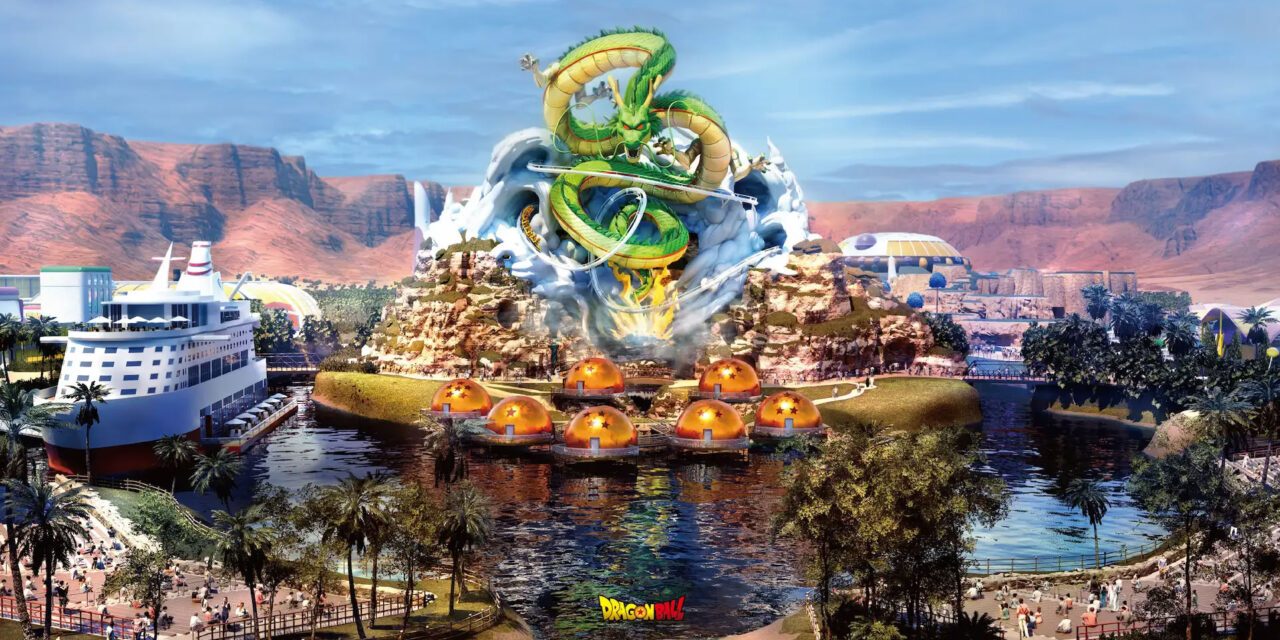
To gauge the scale of what could emerge, a detour via Riyadh is in order. In March 2024, just weeks after the death of Akira Toriyama, Qiddiya Investment Company — the investment arm of the Saudi sovereign wealth fund — announced, together with studio Toei Animation, the world’s very first Dragon Ball park. The project is dizzying: seven zones inspired by the seven Dragon Balls, recreating iconic locations such as Kame House, Capsule Corporation and Beerus’ Planet; more than thirty attractions, five of them billed as “world firsts”; themed hotels; and, as its centrepiece, a 70-metre Shenron with a roller coaster running through its heart. All of it within Qiddiya, a leisure megacity about forty minutes from the capital. It is that reference — spectacular and without equal — that the French version, announced as “more modest,” would have to live up to in the eyes of demanding fans. For the sake of completeness, it’s worth noting: the announcement already drew mixed reactions, with some fans questioning the choice of Saudi Arabia. No opening date has been given there either, for that matter.
Dragon Ball, a cultural given in France
If any project is to succeed where Mirapolis failed, it’s this one — for one simple reason: the demand is already here. Where Mirapolis had to build public attachment to its world from scratch, Dragon Ball arrives with forty years of fame. Akira Toriyama’s work, born in 1984, has sold a staggering number of copies — between 260 and 300 million depending on the count — making it one of the best-selling manga of all time.
And in France more than anywhere, the bond runs deep. Aired on the cult children’s TV block Club Dorothée from 1987 to 1997, the anime enjoyed a dominance hard to imagine today: up to 60% audience share at its peak, a show watched by the vast majority of an entire generation of children, and an estimated 26 to 30 million manga volumes sold in France. That generation, raised on Goku’s battles in the schoolyard, is now grown up — and raising children of its own. France even honoured Toriyama in his lifetime, naming him a Knight of the Ordre des Arts et des Lettres in 2019, five years before his death. A Dragon Ball park at the gates of Paris would therefore address not an audience to be won over, but one to be reunited with.
A mature ecosystem, with memory as a safeguard
The context, too, has changed radically since 1991. France has become Europe’s leading theme-park nation. The 2025 season confirmed it with records tumbling one after another: Puy du Fou passed 3 million visitors, Parc Astérix reached 2.9 million — along with a €250 million expansion plan by 2030 — while Disneyland Paris reigns unchallenged over the continent. Futuroscope, one of our parks of the heart, which we wrote about recently in connection with Mission Bermudes, holds steady at around 2 million entries. The market has never been so dynamic, nor families so accustomed to this kind of leisure.
Still, the Courdimanche site carries a warning etched into its very soil. Mirapolis failed precisely because it aimed too big, too soon, on overestimated attendance. A Dragon Ball project would inherit that advantage — a globally “pre-sold” licence — but also that risk: a version judged too modest against the splendour promised in Riyadh could disappoint. Not to mention the political dimension of the matter, driven by a foreign sovereign fund and already criticised by several local officials for its lack of consultation. The subject isn’t neutral, and it would be dishonest to pretend otherwise.
Presidential passion or strategic calculation?
One question deserves to be asked plainly: is this project born of a genuine taste for Japanese animation, or of a simple economic and diplomatic opportunity? Both, no doubt. Emmanuel Macron has made repeated gestures toward this culture. In 2021, in Tokyo, he met legendary manga artists — Katsuhiro Otomo, the father of Akira, and Hiro Mashima, creator of Fairy Tail — and received a signed drawing from Eiichirō Oda, the creator of One Piece. In April 2026, on an official visit to Japan, he even performed a “kamehameha” in front of the Japanese Prime Minister — an image that went viral. He’s fond of pointing out, too, that France is the world’s second-largest manga market: one comic book sold in two in France is a manga.
Should we see in this a presidential passion? Observers read it mainly as a soft-power strategy: harnessing a pop culture beloved by the French to tighten Franco-Japanese ties and attract investment. The Courdimanche project fits that logic — courting foreign capital, reviving a wasteland, signalling ambition for the cultural industries — far more than any crush on Goku. Which takes nothing away from its coherence: rarely have a site, a global licence and political will seemed so aligned. But that alignment is also a fragility, as a very recent precedent reminds us.
The spectre of Europa City
A few kilometres from Courdimanche, the Val-d’Oise still nurses the bitter memory of another aborted mega-leisure project. Europa City — a commercial and cultural megacomplex complete with a water park and artificial ski slopes, backed by the Auchan group and China’s Wanda — was to rise in the Triangle de Gonesse. Announced budget: €3 billion, for a hoped-for 30 million visitors a year. After years of struggle, the project was abandoned in November 2019: its planning permit had been struck down by the administrative courts, and the government ultimately withdrew its support in the name of environmental commitments. Foreign capital, outsized ambitions, opposition from associations and farmers: it all came crashing down.
The parallel is enough to give pause. But let’s be fair: the crucial difference lies in the land. Europa City was to be built on hundreds of hectares of some of the most fertile farmland in the Paris region — that was the heart of the opposition. Courdimanche, by contrast, is a former leisure site already built over, which largely defuses the agricultural argument that sank Gonesse. The risk isn’t nil for all that: it has simply changed in nature. Because this wasteland, contrary to what one might think, is not empty — more on that shortly. What remains are the pitfalls common to this kind of venture: sensitivity to foreign capital (Chinese yesterday, Saudi today), ever-possible legal challenges, the need for local consultation already being demanded, and above all a dependence on political momentum that has its own expiry date. A park like this is measured in years; a presidential term, by contrast, has a known end.
What such a park could bring to the region
For if the project raises reservations, it also holds a promise it would be unfair to ignore. The eastern Val-d’Oise is an area its own elected officials readily describe as cut off and hungry for appeal. A park of international scale would inject jobs there — from construction to operation, taking in hotels, catering and a host of trades — and give the whole area real visibility.
To measure the potential, one example, to be handled as a ceiling rather than a promise: at the other end of the Paris region, Disneyland Paris claims around 17,000 direct jobs, up to 70,000 direct, indirect and induced jobs, and a cumulative contribution of nearly €120 billion to the French economy since 1992 — roughly 6% of national tourism revenue. A Dragon Ball park would obviously be on a completely different scale, nothing like the giant of Marne-la-Vallée. But the order of magnitude is a reminder: a well-conceived leisure site isn’t just an attraction — it’s an economic engine, a magnet for tourists and a local employer. Even the Communist group on the regional council, cautious as it is, sees a possible jobs opportunity in it. What remains is to turn that potential into lasting reality — which means listening, upstream, to those the project concerns first and foremost.
An inhabited site: consultation as compass
Here is the point most commentary passes over in silence, and one it seems essential to us to state clearly: the Courdimanche wasteland is not empty. Since 2017, a community of Travellers (gens du voyage) has lived there — around a hundred households, some 400 people, including about twenty children enrolled in schools in neighbouring towns. A park project therefore cannot sidestep a simple human question: what would become of these families?
That, to our mind, is where the matter will succeed or fail. The criticisms already voiced — by MP Aurélien Taché as by local officials — do not reject the idea of a park; they call for one precise and legitimate thing: genuine consultation, upstream, with residents, neighbouring towns, associations and the area’s representatives. Recent history, with Europa City just next door, shows it well: a major development only holds up over time if it truly involves its stakeholders, rather than being imposed from the top of the State. Finding dignified rehousing solutions, opening dialogue, sharing the benefits with the local community: these aren’t obstacles to the project, but the conditions of its legitimacy. A family park, by definition, isn’t built against a region — it’s built with it.
Our take as enthusiasts
You know us: we love wandering a park’s pathways as much as rediscovering the worlds that shaped our childhood. This project brings together, on a single plot, our two passions — theme parks and the culture of Japanese animation. Hard, then, not to feel a flicker of excitement. But our role is to keep a cool head. What we see is a site steeped in history, a golden licence, a ready market — and, on the other side, a footprint more constrained than it appears, an inhabited site that will need care, a still-hazy financing plan and the ghost of a resounding failure. The ingredients for a fine rebirth are there; the dosage will decide everything.
What still needs confirming
- Official confirmation: at this stage, no announcement has been made. The project is described as “well advanced,” nothing more.
- The genuinely usable land: about 30 hectares are zoned for leisure in the PLU, out of a total footprint of around fifty; going further would require revising the planning document.
- The future of the site’s current occupants and rehousing solutions — an unavoidable human prerequisite.
- Transport and access, the site’s historic Achilles’ heel, already flagged by regional officials.
- The cost and timeline: an investment put at over €1 billion, with no opening date.
- Local consultation, a sticking point already raised by Val-d’Oise officials.
- Administrative and environmental approvals, the crux of many projects in the Paris region — even though the already-built-over site sharply limits the land-artificialisation risk that sank Europa City.
- The final ambition: a true park worthy of the licence, or a watered-down version?
In short
Mirapolis deserves better than an urbex memory. Whether or not this project comes to fruition, it’s a reminder of an obvious truth: great leisure sites tell the story of an era — its dreams and its mistakes. Going from Gargantua to Goku would be a magnificent symbol — that of a country which, having once set out to celebrate its own legends, would fully embrace those from elsewhere that shaped its youth. We’ll follow this story closely, with as much hope as vigilance, and we’ll come back to you as soon as the facts firm up.
In the meantime, we invite you to revisit our exploration of the great theme parks on the channel, to keep the family outing going. Happy viewing!