

A track composed by hand, rejected for generative AI, cleared the next day, and nobody to say why
On 6 September 2026, a month before my EP Discomposed came out, my distributor told me the second track would not be distributed. The reason given: use of a generative AI trained on unlicensed sources. The piece, Second Movement, was composed note by note in Ableton Live, without a single borrowed sample. I appealed, sent my working files, and the track was cleared the next day. I never found out what had triggered the flag.
The incident is closed, and it ended well. But it says something about how music is now sorted before it even reaches the platforms. Here is what happened, what we know about the tools making these calls, and what I am taking from it.

Rejected on 6 September, cleared on the 7th
TuneCore’s message ran to a few lines. Track 2 was blocked for “generative AI trained on unlicensed sources”. The other five tracks on the EP went through without a hitch. Nothing explained what set Second Movement apart from the other five, or which tool had reached that verdict.
I replied with what I had: the Ableton project for the track, the MIDI files, a screenshot of the session and a proof-of-creation certificate filed with Musicstart. The next day, the content review team cleared the release. My follow-up asking for the actual reason never got a real answer.
A one-day wait is nothing. The calendar is what made it serious. Release was set for 5 October, the opening track was due to be pitched to Spotify’s playlist editors a week later, and any change after 28 September no longer reaches Release Radar, the weekly selection sent to followers. A block of two or three weeks would have meant pulling the track, and so changing the running order of a record built as a six-step arc, or pushing the release back and restarting the whole promotion. For an independent artist with no label to call the distributor, response time matters as much as the decision itself.
Here is the detail that counts: Discomposed contains no samples. The detector did not mistake a loop bought from a sound library for generated content. It judged on something else, and neither the distributor nor I know what. I described how the record was made in the story of the Discomposed EP.
What TuneCore enforces, and why
Under its own rule, the rejection was not arbitrary. TuneCore’s generative AI policy is clear: the distributor only releases music made with models trained on fully licensed data, and any use of a model trained without a licence makes the track ineligible. The page says nothing, however, about how such tracks are spotted, or how to contest a decision.
The context explains the firm line. On 30 April 2026, TuneCore and its parent company Believe announced they would automatically block tracks created, wholly or in part, on unlicensed AI services. Believe’s CEO, Denis Ladegaillerie, described their detection as 99% reliable, according to Music Business Worldwide. Rights holders are pushing in that direction, and a distributor that let infringing tracks through would be directly exposed. I am not challenging the rule. I am questioning the tool that applies it.
99% reliable, but measured by whom?
No distributor publishes a false positive rate, meaning the share of human music wrongly taken for AI. The figures in circulation are the ones the companies announce themselves. Deezer, the most transparent, claims 99.8% accuracy and says it wrongly flags fewer than one human track in 10,000. None of these figures has been independently audited.
Outside measurements are more cautious. A study published in 2025 in the journal TISMIR tested a commercial detector, IRCAM Amplify: it wrongly classified 4.7% of human-made tracks as AI-generated, and simple resampling was enough to fool it. Deezer’s own researchers acknowledge that performance drops as soon as you shift the pitch, add noise or re-encode the file.
The problem is one of scale. Deezer reports receiving more than 50% fully AI-generated tracks on some days. At those volumes, even a very low error rate produces unjustified rejections every single day. One in a hundred looks negligible in a press release. It stops looking that way when it is your track.
I am not the only one
In April 2026, the American band Zao went through exactly the same scenario. TuneCore flagged their unreleased recordings as AI-generated. The band posted a screenshot of their session and a clip of the song, then explained that they could not reach anyone able to explain the accusation. The flag was lifted once the story went public, with no explanation.
Same distributor, same proof through the session, same unexplained reversal. Two cases do not make a statistic, and I will not draw a law from them. They only show that the error exists, that it gets corrected when you can prove how the music was made, and that it stays opaque both ways.
Why ambient may be more exposed
I have no certainty about what tipped Second Movement over. One hypothesis comes up often: the distributor iMusician considers that instrumental, ambient or heavily processed music runs a higher risk of being taken for generated music. It is an industry player’s opinion, with no figures behind it, but it has a logic.
A pad held for several minutes, synthetic timbres, little rhythm and no vocals: these are the hallmarks of my genre, and they are also what a generative model reproduces most easily. A detector trained to spot those textures can confuse them with their origin. If the hypothesis holds, ambient and imaginative music will pay more than other genres for this sorting.
What cleared the track: the production file
The track went out within one working day because I could prove how it was made. The Ableton project dated 12 July, the MIDI files, a screenshot of the session and a proof-of-creation certificate: none of these is decisive on its own, but together they tell a story of human making that a model does not produce.
I have drawn a simple rule from it. I now put that file together when I finish a track, not when a problem comes up: a named project, stems, the original sketch, the certificate. A secondary, almost embarrassing lesson: the file I sent was called “Untitled” followed by a date. A consistent name is part of the proof.
Be careful not to mix up the procedures, though. A proof-of-creation certificate protects authorship of a work; it does not prove the work is human, and no detector consults those registers. I will come back to that distinction, along with rights registration, in a future article.
What should change
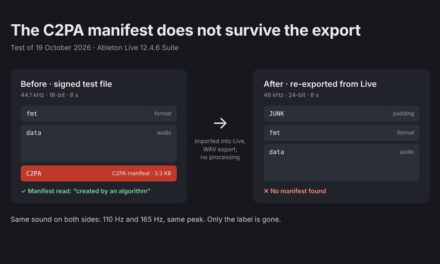
TuneCore corrected quickly, and I give them that. What is missing is transparency. A rejection should at least state the nature of the signal detected, a documented appeal procedure should be public, and the tool’s false positive rate should be measured and published, just as companies already publish their success rates. That leaves the provenance of the files themselves: generators are starting to sign them, but that signature disappears as soon as the file goes through a music workstation.
Another route exists, based on disclosure rather than detection. Spotify relies on AI credits declared by artists through the DDEX standard, and points out that the absence of a credit does not prove the absence of AI. The system is not perfect either, but it puts the burden of truth on the person who knows it. I looked at how the platforms handle AI in our comparison of five streaming platforms.
Listen to Second Movement, then go further
The simplest test is to listen to the track that was taken for a machine, and judge for yourself. Use headphones, at a moderate volume: these are slow pads and harmonies that shift little by little, which is precisely what may have made it look suspicious. Second Movement is the second track on Discomposed, and the EP sits alongside my two albums in Rê>ON’s annotated discography. To hear it among the pioneers of electronic music, the Electronica – Electronic Music Anthology playlist follows that story from the 1950s to today.
If your music has been wrongly flagged, or if you work on the distribution side, write to me through the contact page: I will add documented cases to this article.
Every new Rê>ON track lands in your library the day it comes out. Follow.